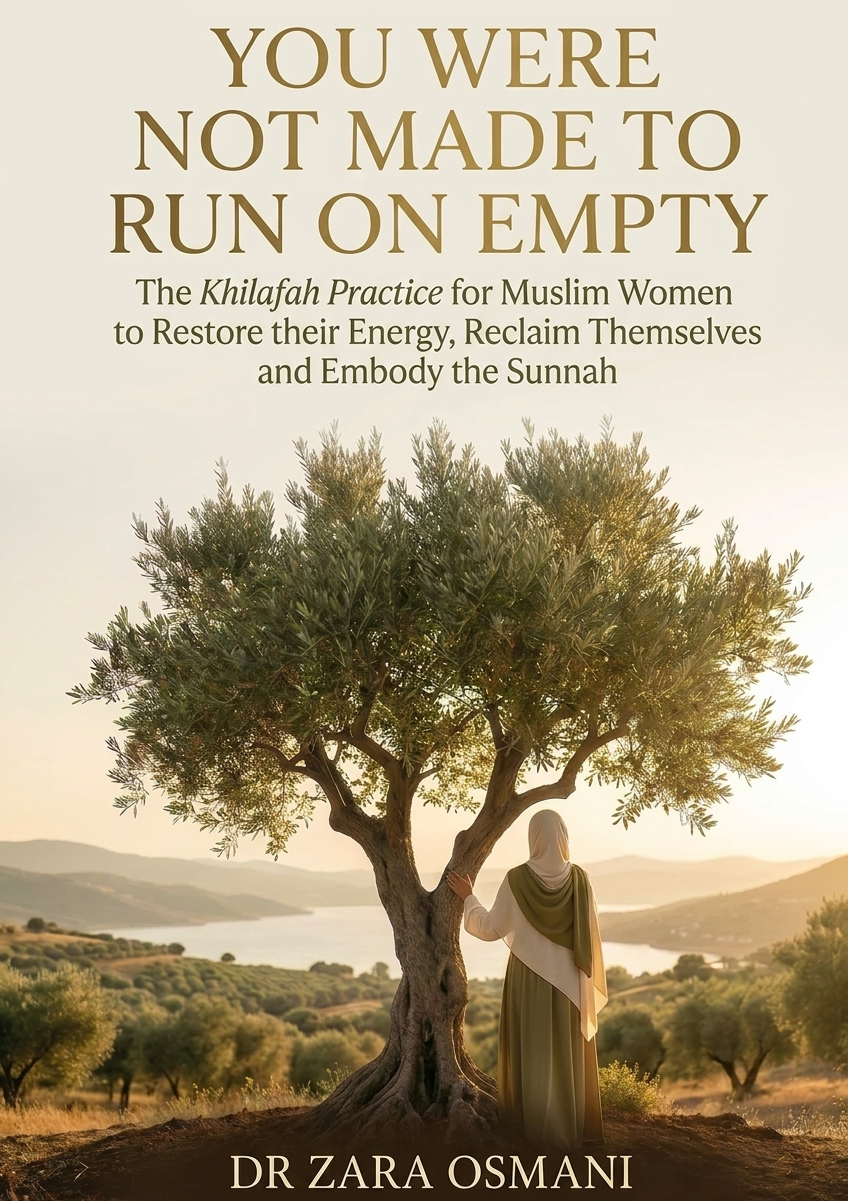
Dr Zara Osmani has released a proven method for how Muslim women struggling with exhaustion, disconnection, and burnout are using one shift - treating body, rest, and deen as a single system - to restore their energy and their presence.
"She's a doctor, so she knows the medicine, but she also actually gets the deen part."
"Dr. Osmani brought me so much reflection and clarity, Alhamdulillah."
"For the first time in years, I felt like myself."
It is eleven at night. The house has finally gone quiet, the dishwasher is humming, and you are on the sofa doing nothing you could justify tomorrow, telling yourself ten more minutes. This hour is the only part of the day nobody else has a claim on. You are not going to give it up easily, and honestly, why should you.
Then Fajr comes and you pray it and could not repeat afterwards what you said in it. By eleven in the morning you are rationing. Two things in the day are worth spending energy on, and everything else quietly gets let go.
Something in you keeps running the same sentences. "I've cut out gluten, I take all the supplements, I'm doing everything right, so why do I still feel like this?" And quieter, later, the one you have never said out loud: "I think something is actually wrong with me, and I'm terrified no one is ever going to find it."
If this sounds familiar, you are not alone, and you are not broken.
Here is what may be closer to the truth. You have been handed a referral pathway when what you needed was a picture of the whole system. Your fatigue goes to one department, your gut to another, your stress to an app you downloaded on a Sunday evening, and your deen sits in a corner no clinician has ever asked about. Each plan is competent. Each is written as though the other departments do not exist. Your body runs all of it as one system, so whatever one plan repairs, the load from the others keeps undoing.
You've done the elimination diets. The supplements. The morning routine you kept for two weeks before life got in the way. Your results keep coming back within range, and you're still exhausted; still not fully present with your children, still going through the motions of salah instead of feeling it.
If any of that sounds familiar, you're not imagining it, and you're not the problem. You've become the fifth expert - holding your fatigue, your gut, your stress, and your deen together yourself, because nobody ever treated them as one system.
Tests do not measure what a decade of unresolved strain does to a body that keeps getting up anyway. Nobody has ever claimed they did. We simply let the reference range quietly stand in for the whole woman.
So both things can be true at once. The result was accurate, and you are not fine.
Six years of medical school never taught anyone to ask what time you actually fall asleep, or whether you have eaten a meal sitting down this month, or what your relationship with stillness looks like. None of that counted as clinical data. It counted as your personal life, which was somebody else's department, or nobody's.
The Islamic wellness corner of the internet gets the thing medicine misses. You are a soul and a body and they were never separate departments. Then it hands you a reminder, and reminders do not construct anything. It stays devotional exactly where you needed it to be clinical.
Which leaves you as the fifth expert. The only person who has seen all of it, holding the dietitian's plan and the sleep advice and the therapist's homework and the saved reels, on about four hours of uninterrupted attention a week, most of it after ten at night. Nobody appointed you to that job. Nobody trained you for it.
January 2025. I was in Thailand, at a health retreat, still on my medication, still going to sleep at one in the morning out of habit rather than choice. I made du'a there with no eloquence left in me at all. Just my name for it and His.
I had earned that state honestly. Joint pain from my early twenties, my mother's Lupus sitting right there in the family history, and tests that kept coming back "normal" for ten years. I said the words in the room. I trained through medical school and then GP training while quietly deciding my own instincts were the unreliable part, because everyone I respected kept pointing at the numbers. In 2018 the brain fog and the memory gaps got bad enough that I resigned. Not bravely. I simply could not hold a thread through a consultation any more, and I was ashamed of it.
The diagnosis arrived in January 2019, a decade after the first symptom. Then two years of steroids and immunosuppressants, taken exactly as written, and at my best on them I was barely functioning. Low-grade fevers. The kind of tiredness sleep does not reach. My children talking to me and me not really in the room with them.
So Thailand was not a retreat in the pleasant sense. It was where the question I had been carrying changed shape. I stopped asking why is this happening to me, which only ever points backwards, and started asking what Allah ﷻ might be directing me towards.
Six months later I sat down and wrote out what I had actually altered. There were three things. I had protected the window between Isha and Fajr. I had eaten whole, tayyib food, sitting down. I had kept my dhikr steady instead of squeezing it into whatever was left of me at eleven at night.
Then I put that short list beside the six pillars of lifestyle medicine, the ones I had trained in, and they matched. I had not designed a clinical intervention. I was far too unwell to be that clever. I had followed a Prophetic rhythm because it was the only thing left that asked nothing new of me, and it produced one anyway.
Picture your week as a container with a small leak somewhere underneath it. For years now, supplements and protocols and fresh resolve have been poured in at the top, and the level never seems to rise. Nothing was wrong with what you poured. Nobody had looked underneath.
Sealing the leak asks something different of you than another plan does. It asks you to hold your body as an amanah, a trust handed to you for a limited time, that you will one day be asked about. Not a project to perfect. Not a load to carry until the children are grown.
There is a quiet difference between a woman optimising herself and a woman stewarding something she has been entrusted with. Optimising runs a cost benefit sum every morning, so when the week turns hard the sum shifts and the practice quietly goes. Stewarding holds steady on the hard weeks in particular, the way your prayers do. Nobody drops a prayer on the grounds that the day was heavy.
That single reordering is what tends to make this last past week three, and it is why so much of it may already feel familiar to you.
Six pillars, run as one system. Not a sixth specialist added to the four you already have, and not a protocol laid on top of an unchanged week.
Every practice in the book arrives twice on the same page: the hadith or ayah that prescribes it, and the peer-reviewed evidence that confirms it, with the settled findings marked as settled and the promising ones marked as promising.
It works at the level of the whole system rather than the loudest symptom, which is why it tends to hold when the elimination diet and the supplements did not. It sits alongside your medical care, never in place of it. Dr Zara Osmani still takes her medication and still sees her specialists.
Sleep and stillness go first. The book explains why the order matters more than almost anything else, and why starting with food is the most common reason a good plan stalls at a fortnight.
"Dr. Osmani brought me so much reflection and clarity, Alhamdulillah. The way she explained, guided, and answered questions with such wisdom and compassion was very impactful."
“Dr Osmani explained why your bloods being normal doesn't mean you're well, and suddenly ten years of being dismissed finally made sense. She's a doctor, so she knows the medicine, but she also actually gets the deen part. She doesn't treat them as two separate things you have to choose between."
"During one of the hardest and most overwhelming seasons of my life, her presence has meant so much to me. She has shown up with compassion, patience, and understanding when I really needed it."
One client came convinced she had a gut problem nobody had managed to crack. Eliminations done. Supplements taken. Referrals exhausted, and nothing conclusive at the end of them. Looking at her food, there was very little wrong with it. What stood out was how she was eating it: every meal in the ten or fifteen minutes between two other things, in a body that had not stopped since Fajr.
Her food never changed. What changed was intentional stillness before meals, held as a physiological trigger rather than an extra devotional item. Her digestion began responding within weeks, and at three months her own GP confirmed her inflammation markers had come down.
"Fatima", a mother running a household and a career, came looking for a tighter routine and more discipline. Nothing was added. Rest was simply moved out of the category of laziness and into haq al-jasad, a right her body holds over her. Within a couple of months she had more energy than she had felt in years, having done less rather than more.
Dr Zara Osmani is a Lifestyle Medicine doctor, doctor of Traditional Islamic Medicine and Islamic Life Coach who was failed by the system she trained in. MBChB, seventeen years as a doctor, BSLM through the British Society of Lifestyle Medicine, and an Alimiyyah student who is careful to say she is on the path to scholarship rather than at the end of it.
Ten years undiagnosed. Two years correctly medicated and still barely functioning. Then a slow, documented recovery once she stopped running her faith and her health as two separate projects, alongside her medication and her consultants, not instead of them. Her mission is simple enough to say in one line: a Muslim woman should never be made to choose between her deen and her health.
Picture a Tuesday you are actually awake for. Breakfast eaten sitting down. A prayer you are inside rather than getting through. Your children talking at dinner and you following the thread well enough to ask a second question. A hard week that costs you a bad morning instead of a lost month.
You are not starting from zero. Most of this you already practise, in fragments, in a column of your life nobody ever connected to your health.
Get the book, read it this week, and if afterwards you would like someone to look at your whole system with you rather than one department of it, let's have a conversation. No pressure attached to it.
You were not made to run on empty.